
Verinode IQ
Cycle Time.
Where every job loses days.
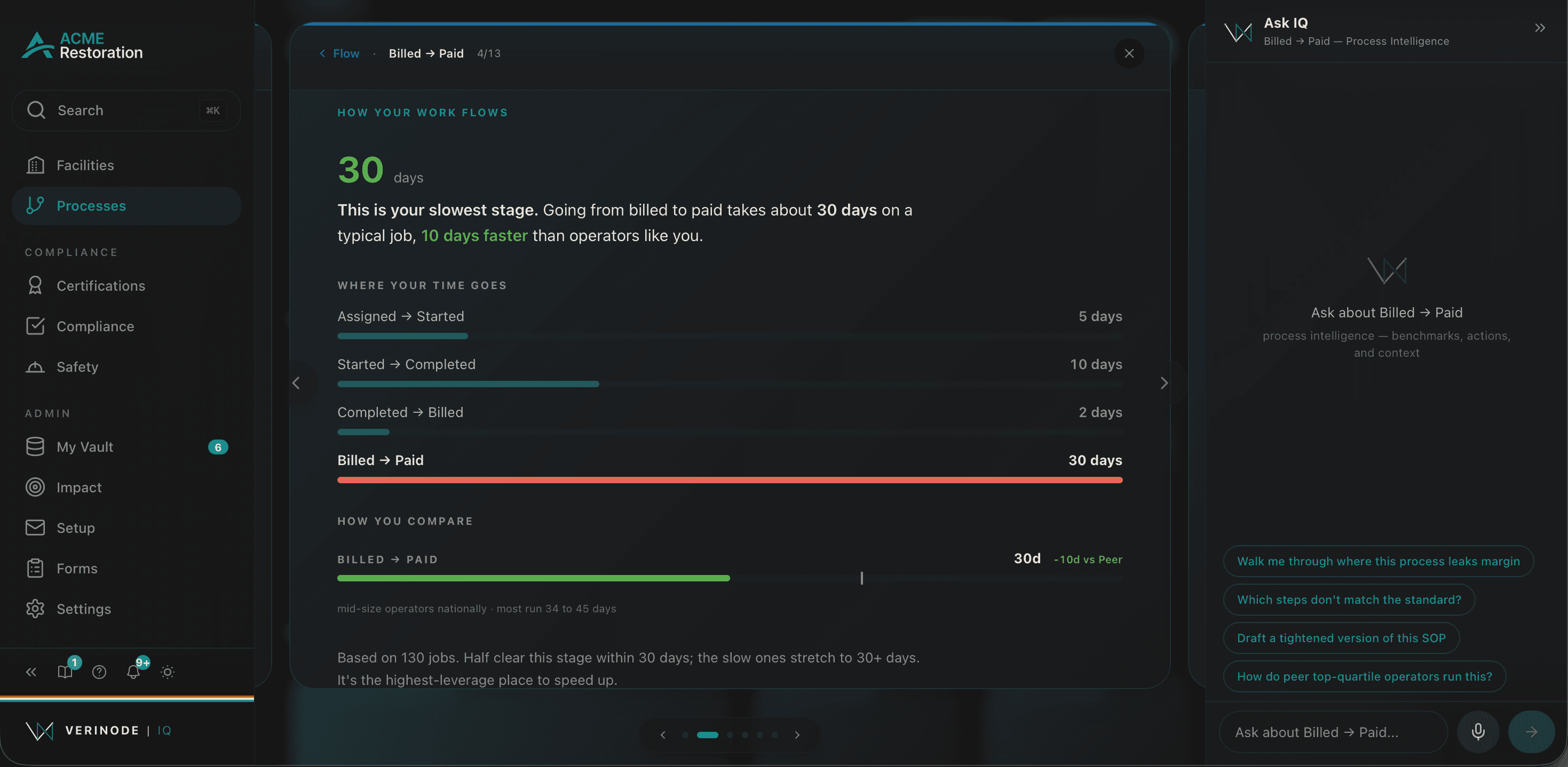
First notice of loss to paid, stage by stage.
app.verinode.ai
Your Cycle, Against Theirs
Every extra day a job lingers is a day your crew and your cash stay tied up.
Your job cycle
We'll show you exactly where you land, the moment you're in.
What membership includesThe same job, weeks faster at the business across town.
Your full cycle set beside operators your size, so the one stretch where you give days away stops hiding inside the average and turns into your next gain.
app.verinode.ai · Process
How It Works For You
Your jobs flow in
Estimates, job records, invoices, payments. It comes in automatically. The dates are already there.
It times every stage
Each job reconstructed stage by stage, every stage set against operators your size.
You take the days back
The slowest stage and the cash and capacity it ties up, drafted as a decision.
Common Questions
What operators ask first.
What is cycle time in restoration?
Cycle time is how long a job takes from first notice of loss to a paid invoice, broken into the stages in between: assigned, started, completed, billed, and paid. Each stage has its own clock, and the total is the one that ties up your cash and your crews.
How does Verinode measure it without me logging anything?
It reads the dates that already exist in your estimates, job records, invoices, and payment confirmations, then reconstructs the timeline for every job. You don't keep a stopwatch, the timestamps are already in the documents you have.
Which stage should I focus on?
The one where you're slowest relative to your peers, not just the longest in absolute days. Verinode flags the stage with the biggest gap to operators your size, because that's where a few days back is worth the most cash and capacity.
Is my data safe?
Your raw data lives in its own encrypted database scoped to your account. Only anonymized aggregates reach the benchmarks, and your data is never sold to insurance carriers or shown to another operator. The benchmarks never expose an individual operator, and the policy, architecture, and methodology are all published.
What Makes It Verinode
Why Operators Join
The fastest operators in your cohort aren't working harder. They know which stage to lean on.
That is what membership shows you: your cycle next to theirs, stage by stage, until the slow one has nowhere to hide.