
Verinode IQ
Carrier Scorecards.
Every carrier's targets, met or missed.
Scorecards read the same way for every operator.
app.verinode.ai
The Bar That Keeps The Work
A few points under the bar is how programs quietly slip away.
Your scorecard
We'll show you exactly where you land, the moment you're in.
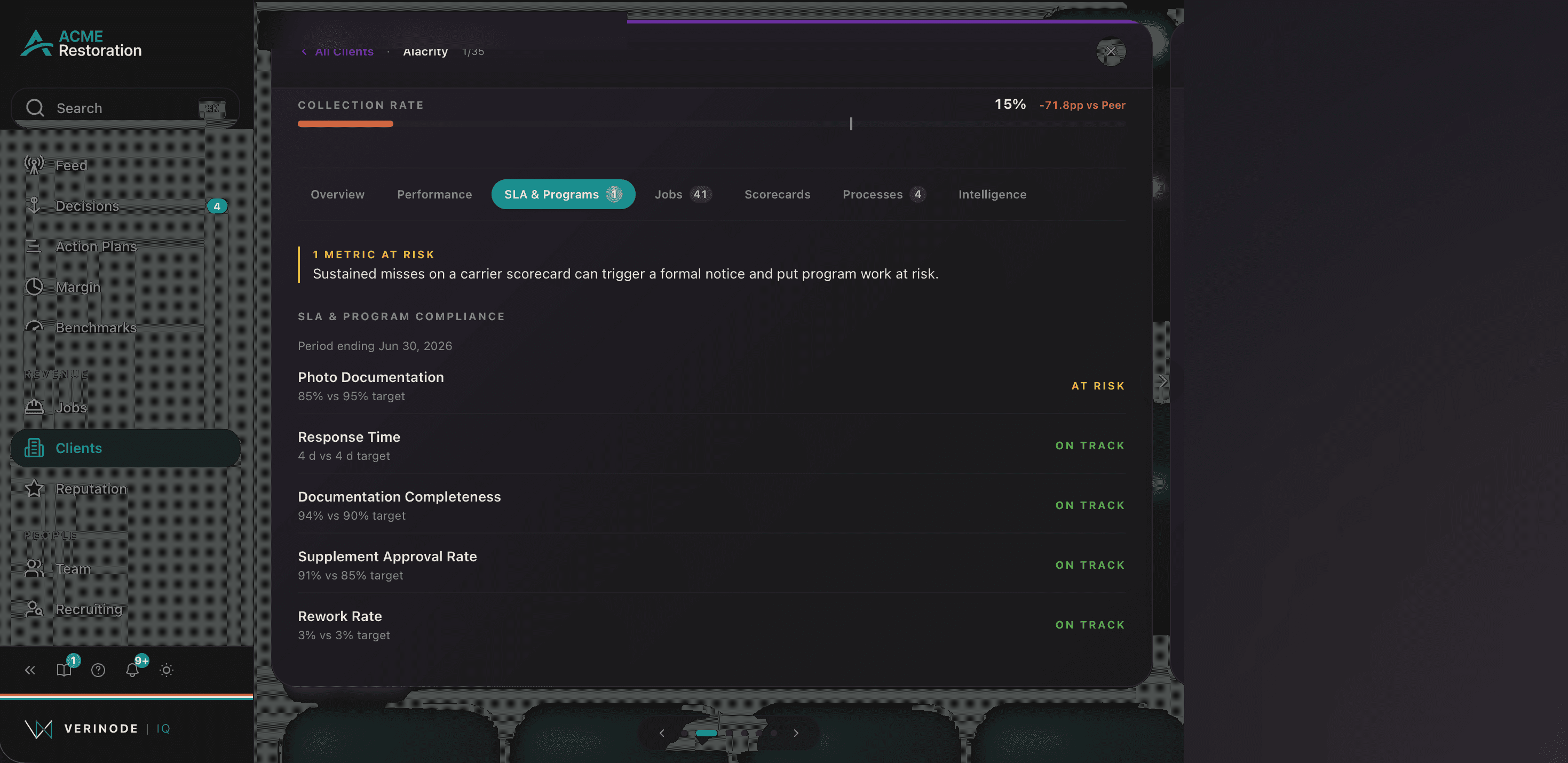
What membership includesEvery SLA tracked the way the program scores it.
Photo documentation, response time, completeness, by program. The metric at risk surfaces before it shows up on a notice, with the jobs behind it.
app.verinode.ai · Clients
How It Works For You
Your jobs flow in
Estimates, photos, timestamps. It comes in automatically. Verinode reads what the program will measure.
It scores you live
Every SLA tracked continuously against the program's bar, not reconstructed at quarter end.
You act in time
The metric at risk and the jobs driving it, surfaced as a decision while you can still move it.
Common Questions
What operators ask first.
What is carrier SLA and scorecard tracking in restoration?
Carrier programs grade operators on service-level metrics like cycle time, response time, documentation completeness, and approval and collection behavior. Your standing on those scorecards decides how much program work flows to you. Tracking them means measuring each metric against its target continuously, instead of finding out where you stand at the quarterly review.
How does Verinode track my scorecards?
It reconstructs each SLA and program metric from your own job records and scores it against the program's stated target, marking each one on-track or at-risk. The moment a metric trends under target, you get the warning with the specific jobs driving it, so you can act while it still counts.
Can it tell me if a target is unrealistic?
It shows your program metrics next to operators your size, so you can tell the difference between a target that is unusually strict and a gap in your own process. That peer line is real operator data and never exposes an individual.
Is my carrier and job data safe?
Your raw data lives in its own encrypted database scoped to your account. Only anonymized aggregates reach the benchmarks, and your data is never sold to insurance carriers or shown to another operator. The benchmarks never expose an individual operator, and the policy, architecture, and methodology are all published.
What Makes It Verinode
Why Operators Join
The operators who keep their programs see the scorecard coming. They're members.
Finding out at quarter end is the expensive way to learn a program slipped. Members catch it while there's still time.